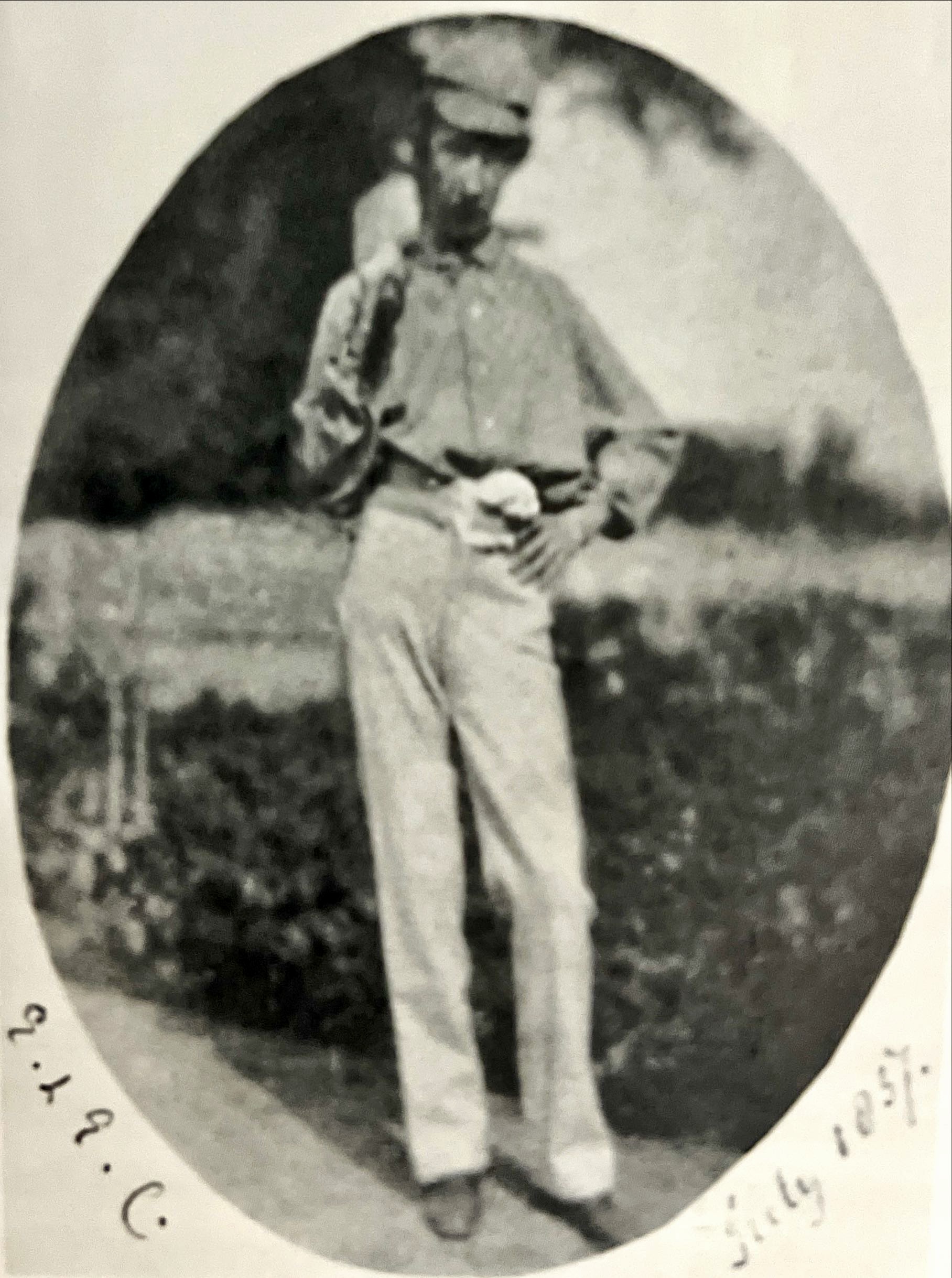
Village cricket may have started in Frocester in 1857 and the club appears to have been well established by 1874 when a 2nd XI scored 127 in their first innings, to finally beat Leonard Stanley at Frocester by 119. One player scored sixty.’ The club had no ground of its own, but relied on the kindness of its farmer members for temporary venues. In 1884 the first match of the season, played on 1 May against Eastington, was lost. The outcome of one against Coaley is not known. John Altham Graham-Clarke, Frocester’s major landowner, was among the earliest patrons of the club. Its President, Charles Chapman, who came to Frocester as a farm pupil, married into the Hayward family, and was tenant of Court Farm for ten years, went on to play for Derbyshire.
Interest then appeared to have lapsed until 1889, when a meeting was held at the George Inn to revive it.” Mrs Graham-Clarke was elected President and Revd W Symonds, Captain F Parry and E Blackwell and W Thorpe were vice-presidents. The team’s captain and vice-captain were L A Graham-Clarke and T G Hawkins, and the committee members included five farmers and Thomas Deacon, the blacksmith. The President allowed the club to use the Manor Park for their pitch during the forthcoming season. Thereafter the annual results continued to be recorded intermittently in the parish magazines. In 1905 Frocester beat Slimbridge on Whit Monday, and Stroud Rovers at the end of the season. However, it was noted that the club was occasionally disadvantaged by the non-appearance of promised players because they had to reach away matches as best they could by horseback, carriage or on foot; the use of bicycles was still rare. The results for that season were only four wins, with five draws and seven defeats. The most regularly used site for home matches was Little Nutfield, by permission of E Blackwell, and this field continued to be the favourite venue until the First World War.
In 1920 those who returned from the conflict and the younger lads in the village restarted the cricket club. Initially no regular team existed, and members only played matches among themselves. Their equipment comprised the stumps and bails, two bats and balls, and a pair of pads and gloves for the wicket keeper. Two years later, however, fixtures were arranged with local teams such as Eastington, Frampton, King’s Stanley, Nympsfield, Slimbridge, Stinchcombe and Whitminster. A match against Cadbury’s (Frampton depot) second XI was lost by 17 runs.
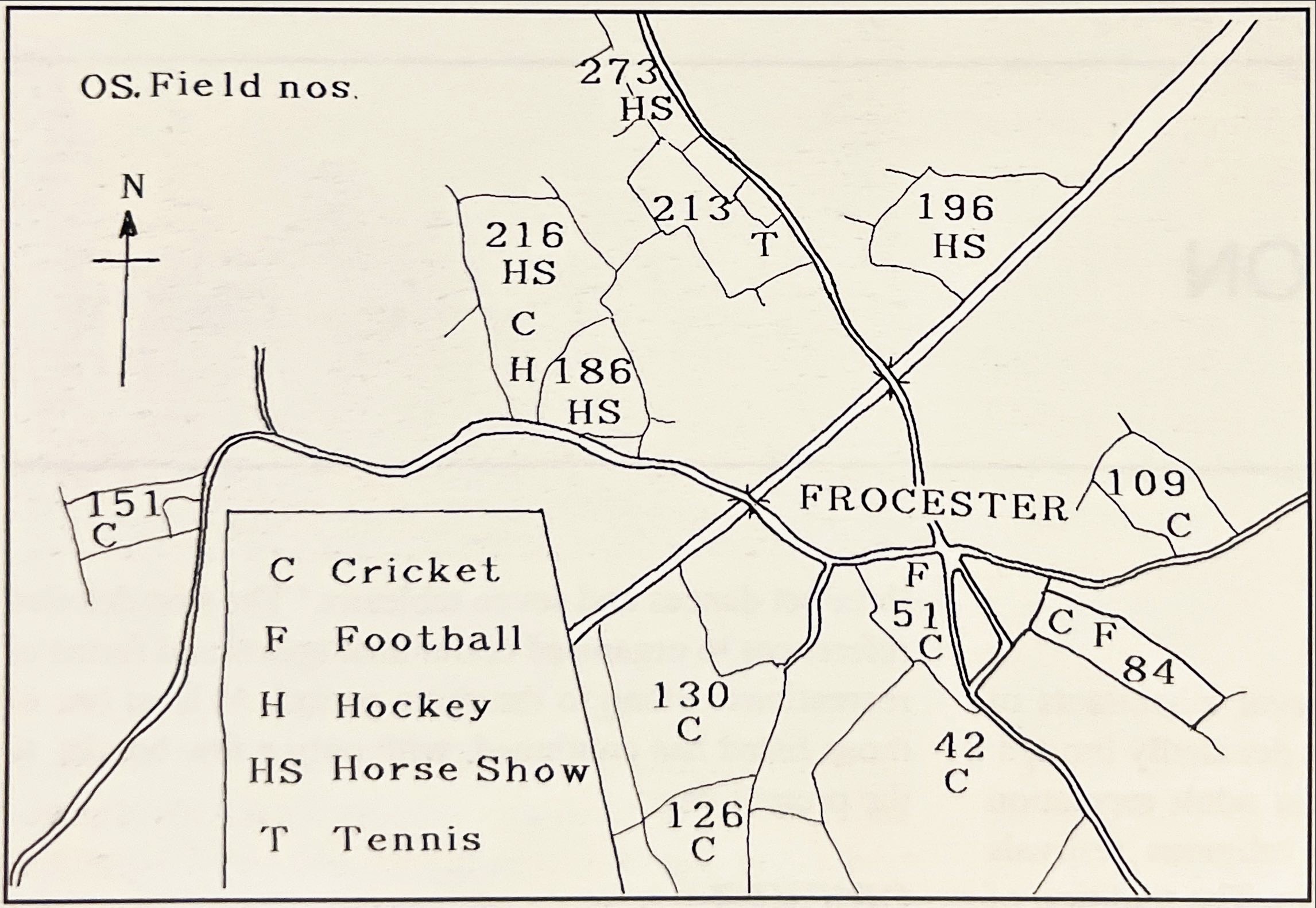
For the next ten years home matches were played in Little Nutfield, Big Stanborough, and Broad-meads by permission of Charles Jeffes, in Long Field and the Hurns by Arthur Chamberlayne, and in part of Pound Close. These temporary seasonal pitches were never fenced, but a suitable flattish part of the site was scythed, mown and rolled as the occasion required.
Animal droppings were removed on the day of a match with a shovel and bucket, and the outfield was usually rough and often undulating ridge and furrow. Pavilion and toilet facilities were non-existent, and it was said that ‘you couldn’t flush, only blush’/ There were no refreshments, but usually plenty of cider. In 1933 the club’s management committee comprised Revd F M Vine, chairman, S A Rugg, J Aldridge, with the team’s captain and vice captain, TW Goodchild and J A Chamberlayne, ex officio members. Club membership stood at about thirty-two, each paying a 4s annual subscription. The financial balance stood at £5 8s 3d.
On 25 June 1935 a proposal that Eastington and Frocester should combine and have a permanent playing field received little support. At the meeting Rear Admiral Richard Bevan, a member of the National Playing Fields Association, who had recently come to live at Osborne House, was told that Frocester says: We are very comfortable as the farmers are very kind’ ! A field on Frocester Farm was, however, not available for use the following year, so Bevan approached the author’s father, Charles J Price, who had recently come as tenant to Court Farm and it was agreed that the club should have the regular use of the old pitch in Little Nutfield. This was then enclosed with removable fencing on posts set into concrete sockets, and the shed on the west side of the field acted as a changing room or pavilion.
Local fund-raising activities, often arranged with the help of wives and lady associates, who also ran the catering for home match teas, were started almost immediately. These were continued each year there-afer to finance and improve the existing facilities. An invitation for opponents put in the Stroud News led to a total of eight home and six away matches being played during the 1936 season, some of them held on Thursday evenings. Saturday matches included those played against Cadburys of Frampton, Eastington, Edge, Haresfield, Kings Stanley, Miserden, Rodborough and Stonehouse. A green cricket cap with a suitable club monogram was obtainable for 4s 6d from Whites of Stonehouse, but it was agreed that the club would pay Is each for merit badges. White flannels were considered preferable for the players, and coats of a similar colour were provided for the umpires. The rota of members for voluntary pitch maintenance was found to be unsatisfactory, and in 1938 Tom Goodchild and Barham were appointed permanent groundsmen.
The club finances had improved and part of a credit balance of £11 17s 8d was spent on a new handle for the stone pitch roller and a table and two chairs for the scorers. It was agreed to purchase a practice bat and three balls, two pairs of batting gloves, a scorer’s book and a cricket carpetbag in which to transport such items. Some of this kit was eventually donated to the club. Tuesday evenings were devoted to practice sessions, with Friday as an alternative date. A verandah was added to the front of the pavilion shed to improve the facilities, and a large elm tree trunk alongside it acted as a grandstand for spectators.
 FROCESTER CRICKET CLUB